
January 23, 2026
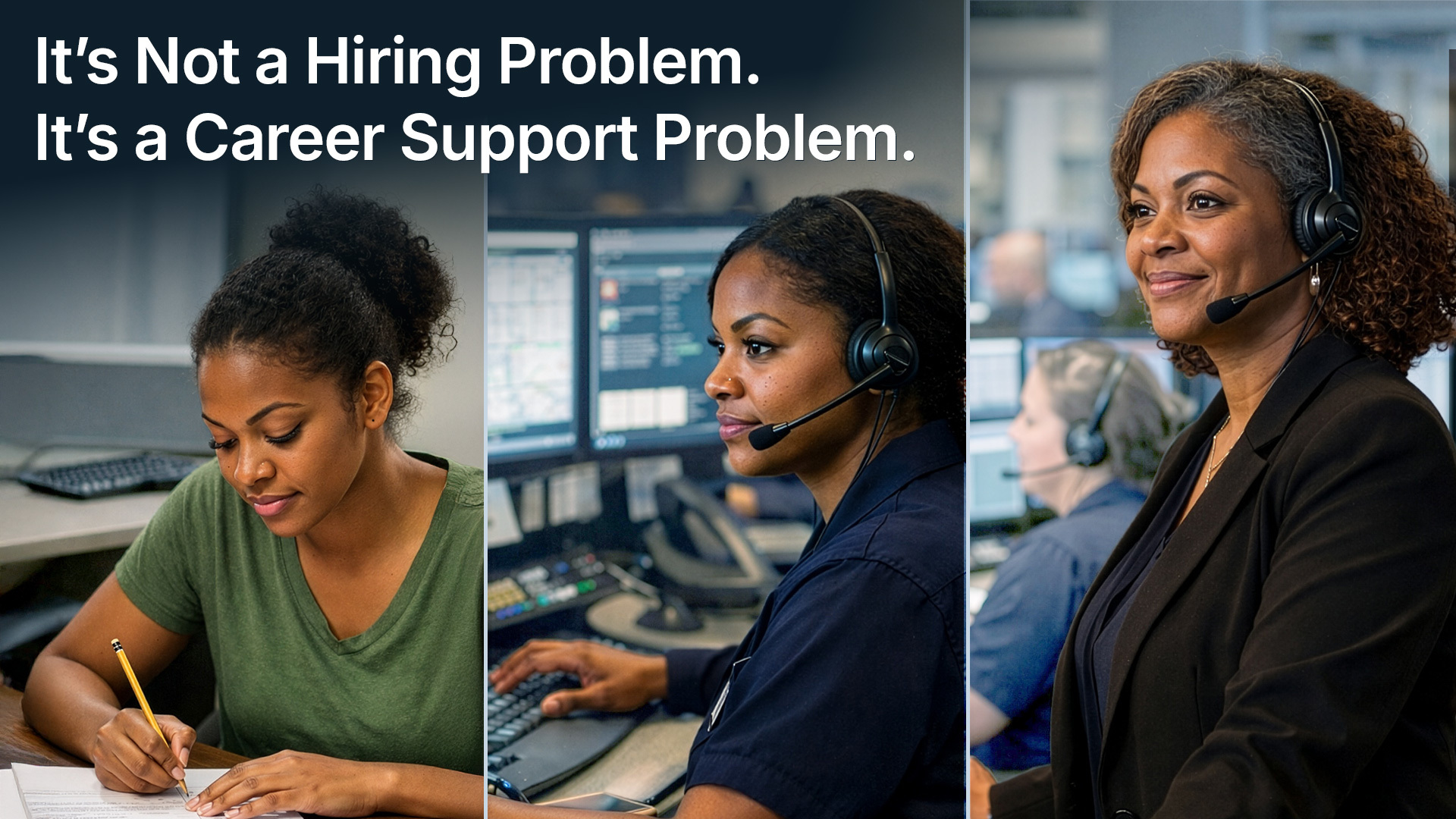
Every 9-1-1 leader can tell you how difficult it is to fill seats and keep them full right now.
Applicant pools feel thinner. Training pipelines feel longer. Floors feel more fragile. And the pressure never lets up.
So the default conclusion is understandable: this must be a hiring problem.
But if you’ve lived it, you know that’s not the full story.
Many centers are hiring. Some are even hiring consistently. Yet they still see people wash out during training, struggle after sign-off, or quietly burn out a few years in. Meanwhile, the experienced telecommunicators who anchor the room carry more and more weight until there’s nothing left to give.
That’s not a hiring problem.
That’s a career support problem.
And it’s difficult to solve because the telecommunicator’s career is rarely managed as a connected system.
Most agencies have the right components:
But the breakdown happens when those components operate in isolation.
Hiring is treated as an HR function.
Training is treated as a trainer function.
QA is treated as a compliance function.
Real-time support is treated as a supervisor function.
Wellness is treated as an individual responsibility.
Retention is treated as a budget problem.
The telecommunicator experiences none of these as separate. They experience them as one continuous reality.
A candidate enters training carrying the expectations set during hiring.
A trainee hits the floor carrying the confidence (or doubt) built in training.
A newly released telecommunicator carries the coaching patterns reinforced through QA.
A veteran carries the cumulative weight of critical incidents, overtime, and cognitive load.
When the system is disconnected, the person is forced to bridge the gaps. That’s how careers become fragile.
The job isn’t getting simpler.
Call volume remains high. Complexity continues to rise. Community expectations grow. Policy requirements expand. Budgets are diminishing. Documentation and defensibility matter more than ever. And as staffing tightens, the buffer disappears.
In that environment, small cracks spread fast:
Many centers try to fix each of these independently.
The centers that stabilize long-term performance do something different.
They treat career support as a loop, not a checklist.
A more useful way to think about performance and retention is Candidate Through Career (C2C).
C2C recognizes that hiring, training, QA, and support are not separate initiatives. They are reinforcing stages of a single lifecycle.
Not a funnel.
Not a one-time onboarding process.
A continuum.
The simplified model looks like this:
When these stages reinforce each other, careers become resilient.
When they don’t, centers pay for it through rework, repeat issues, and churn.
AI often enters this conversation the wrong way. When technology is introduced as the solution, it creates fear and skepticism. It can feel like someone is trying to automate away the profession.
That’s not what 9-1-1 needs.
The telecommunicator isn’t the problem. The telecommunicator is the mission.
Used responsibly, AI adds value only where systems break down due to:
AI is effective when it:
AI is not a replacement.
It’s a force multiplier for the people already doing the work.
Most centers hire using the best signals available: interviews, typing tests, backgrounds, references. These matter, but they don’t fully test the reality of the job.
The job requires:
AI-assisted simulations and structured assessments provide a more realistic preview of the work and more consistent insight into readiness.
Leadership keeps control.
Candidates gain clearer expectations.
Early mismatches are identified sooner.
That’s career support from day one. The candidate is set up for success from day one.
Completion doesn’t equal readiness or completing a checklist.
Readiness is demonstrated through performance, repetition, and feedback, but trainers are stretched, staffing is tight, and learning speeds vary.
AI-assisted training tools help by:
This doesn’t replace trainers.
It protects them. It supports them.
QA often fails not because standards are wrong, but because:
AI-assisted QA helps by:
This isn’t about catching mistakes.
It’s about fairness, clarity, and development.
That’s career support in the middle of the journey, where many decide whether or not they’ll stay.
The calls that break people aren’t always the obvious ones.
Sometimes it’s ambiguity.
Sometimes accumulation.
Sometimes one overloaded moment.
Real-time AI assistance can help by:
That support matters for new staff and veterans alike, without shame, without judgment.
Here’s the reality most centers feel once it’s said aloud:
You can’t coach your way out of a hiring mismatch.
You can’t hire your way out of inconsistent training.
You can’t train your way out of punitive QA.
You can’t QA your way out of missing real-time support.
And you can’t fix retention without supporting the full journey.
Resilient centers treat performance as a loop:
When the loop is connected, improvement compounds.
Standards survive turnover.
Careers last longer.
The most important question isn’t: “How do we hire more people?”
It’s: “Where do we lose people in the journey and what support is missing just before that point?”
The answer is rarely just pay or hiring speed. It’s usually a gap in support.
And gaps can be closed when centers stop treating hiring, training, QA, and operations as separate worlds.
9-1-1 is not just a job category. It’s a profession. And professions are sustained by systems that develop people over time.
The future of staffing isn’t filling seats faster. It’s supporting telecommunicators through their careers with clarity, consistency, and confidence, shift after shift, year after year.
That’s the C2C mindset.
Not candidate to career.
Candidate through career.
And it’s how experience stays in the room.
Staffing challenges in 9-1-1 aren’t just about hiring—they’re about career support. When hiring, training, QA, real-time support, and wellness operate in isolation, telecommunicators are forced to bridge the gaps, leading to burnout and attrition. Centers that stabilize performance treat support as a continuous lifecycle, not a checklist. By connecting systems from candidate through career, agencies build resilience, consistency, and long-term retention—keeping experience, confidence, and capacity where it matters most.

.png)
.png)
.jpg)
.png)


.png)

.png)
.png)
.png)

.png)
.png)
.png)
.avif)


.avif)
.avif)
.avif)

.avif)
