

How AI Coaching Tools Improve 9-1-1 Dispatcher Performance
 Link Copied!


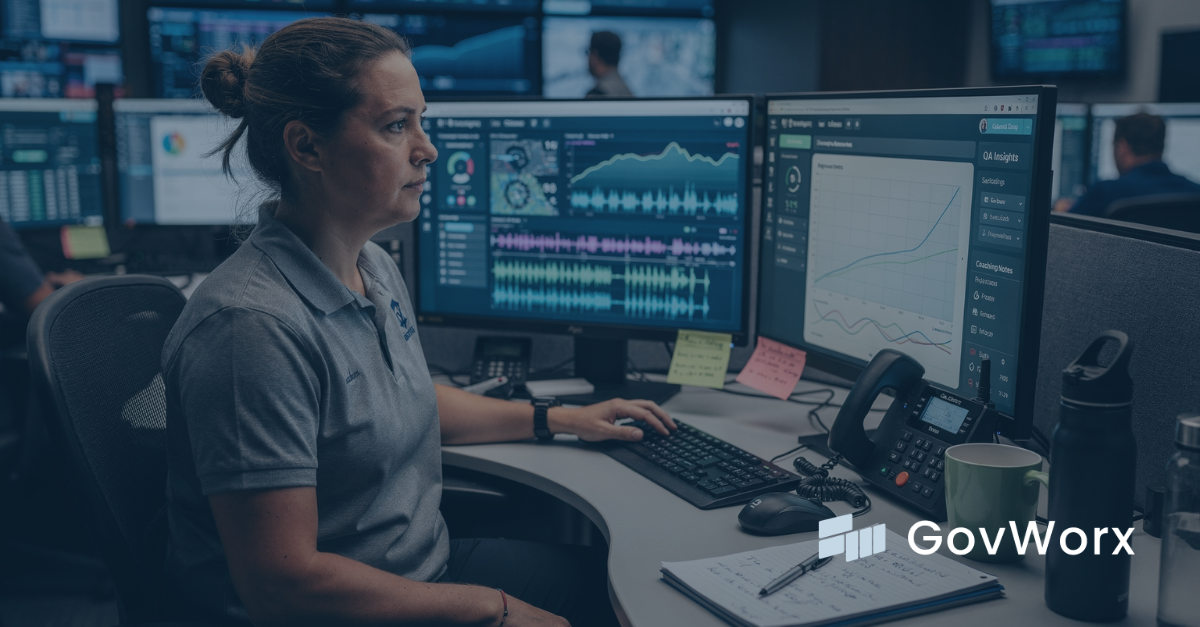
The average 9-1-1 center processes thousands of calls a month. The average shift supervisor can manually review a fraction of them. That gap — between the volume of performance data that exists and the amount any human team can actually act on — is where dispatcher development stalls, protocol drift goes unchecked, and coaching becomes reactive instead of intentional.
AI coaching tools are closing that gap. The research on what they can do is compelling. But not all implementations are built for the specific demands of emergency communications — and generic call center technology adapted for 9-1-1 rarely delivers what the environment actually requires.
CommsCoach is built differently. Here's what the evidence shows AI coaching can do for dispatcher performance, and how CommsCoach delivers it in an ECC context.
The Performance Problem No Supervisor Has Time to Solve Alone
Supervisors in 9-1-1 centers are already carrying more than the org chart shows. They're managing shift dynamics, responding to critical incidents, covering vacancies, supporting trainees, and making real-time operational decisions. Systematic, consistent performance coaching — the kind that actually changes dispatcher behavior over time — requires bandwidth most supervisors simply don't have.
The result is a familiar pattern: coaching happens after the bad call, not before the pattern becomes a problem. Training is front-loaded into the academy, then largely disappears. QA is either manual and inconsistent, or it doesn't happen at all.
That's not a failure of leadership. It's a structural problem — and it's one that AI coaching is specifically designed to solve.
What the Research Shows AI Coaching Actually Does
The evidence base for AI coaching in high-stakes communications environments is growing, and the results are specific enough to matter:
Faster, more consistent call handling. AI-assisted systems reduce the time dispatchers spend on manual data entry and call documentation, freeing cognitive bandwidth for the judgment calls that require a human. In testing environments, AI support has produced measurable reductions in call-processing times and improvements in protocol adherence across shifts.
Quality assurance at scale. Manual QA reviews cover a small percentage of calls — and they're subject to reviewer fatigue, inconsistency across supervisors, and the inherent bias of reviewing calls you already know about. AI can review call volume at a scale no human team can match, flagging missed protocol steps, compliance gaps, and coaching opportunities consistently across every shift, every supervisor, every telecommunicator.
Training that builds real-world readiness. Script-based training exercises don't prepare dispatchers for the emotional reality of the console. AI-powered simulation platforms can replicate the tone, urgency, and unpredictability of distressed callers — including high-acuity scenarios and rare call types that trainees might not encounter in their first months on the floor. That kind of realistic practice accelerates skill mastery and gives supervisors clearer, earlier performance data.
Reduced cognitive load and burnout protection. By automating routine tasks — transcription, call summarization, key detail extraction — AI tools allow dispatchers to stay focused on caller management and decision-making rather than administration. In a profession with one of the highest burnout rates in public safety, reducing unnecessary cognitive load is not a nice-to-have.
Targeted, personalized coaching. Aggregate performance data identifies patterns — common delays, recurring protocol gaps, high-performing behaviors worth replicating — that no individual supervisor has the visibility to see. That data enables coaching that is specific, evidence-based, and tied to real call behavior rather than impressions or spot checks.
In CPR-specific testing, for example, an AI coaching agent outperformed human dispatchers on checklist adherence and advanced CPR instruction — a result that underscores what's possible when AI is built to support the specific, high-stakes decisions emergency communicators have to make.
How CommsCoach Delivers This in a 911 Environment
Generic AI coaching tools are typically adapted from enterprise call center platforms. They're built to optimize call-handling time and customer satisfaction scores. The performance dimensions that matter in 911 — stress tolerance, protocol adherence under pressure, information accuracy in life-safety situations, consistent decision-making across a 12-hour shift — require something built from the ground up for emergency communications.
CommsCoach is that platform.
CommsCoach TRAIN prepares telecommunicators before the call comes in. AI-powered simulation gives dispatchers realistic practice on high-acuity scenarios and rare call types in a low-stakes environment — replicating the tone, urgency, and unpredictability of distressed callers that scripted exercises can't replicate. Supervisors get objective, consistent performance data from every simulation, not just the calls they happen to observe.
CommsCoach ASSIST supports telecommunicators during the call. Real-time AI guidance surfaces the right prompts, protocol steps, and next-best actions at the moment they're needed — reducing cognitive load when call volume stacks, helping dispatchers maintain accuracy under pressure, and ensuring nothing critical gets missed regardless of shift, experience level, or how long that telecommunicator has been at the console that night.
CommsCoach QA closes the loop after the call. Automated review extends quality assurance across call volume no manual process can cover — flagging protocol gaps, compliance issues, and coaching opportunities consistently across every shift and every telecommunicator. Supervisors get the visibility to coach proactively rather than reactively, and centers get the trend data to identify where performance is improving and where it isn't.
Together, CommsCoach components cover the full performance cycle: prepare, support, improve. Not a collection of point solutions, but a connected platform with data that informs every stage — and compounds over time.
The People Are Still the Point
No algorithm answers the call. No AI system tells a father his child isn't coming home, talks a suicidal caller back from the edge, or makes the split-second judgment that changes the outcome of a mass casualty event. That work belongs to telecommunicators — and it always will.
The right question was never whether AI can replace the people on your floor. It's whether the people on your floor are getting what they need to do that work at their best. Consistent coaching. Realistic training. Feedback that's specific, timely, and tied to real performance — not the three calls a supervisor happened to review this month.
That's the problem CommsCoach is built to solve.
AI handles the parts of development that scale can't: reviewing call volume no human team could cover, surfacing patterns across hundreds of interactions, delivering practice scenarios that prepare new dispatchers for calls they haven't taken yet. That's not replacing human judgment — it's making sure your best people spend their time on the work that actually requires a human.
Your dispatchers are already capable. The goal is to build the systems around them that let that capability compound over time — so the telecommunicator who joined your center two years ago is meaningfully better today than they were on day one, and the supervisor running your overnight shift has what they need to develop the team below them.
CommsCoach is built on that philosophy from the ground up. Not AI instead of your people. AI in service of them.
The Outcome ECCs Are Actually After
The goal isn't AI for its own sake. It's a more stable, better-prepared workforce — one where dispatchers develop faster, perform more consistently, get coaching that's specific to their actual call behavior, and stay in the profession longer because they feel supported rather than set up to fail.
AI coaching, deployed thoughtfully in an integrated platform built for 9-1-1, makes that possible at a scale that was not achievable before.


AI That Elevates the Impact of ALL Responders
and provide real-time support for first responders.
