

True AI-Driven QA/QI in 9-1-1 Is Not About Reading a Transcript
 Link Copied!


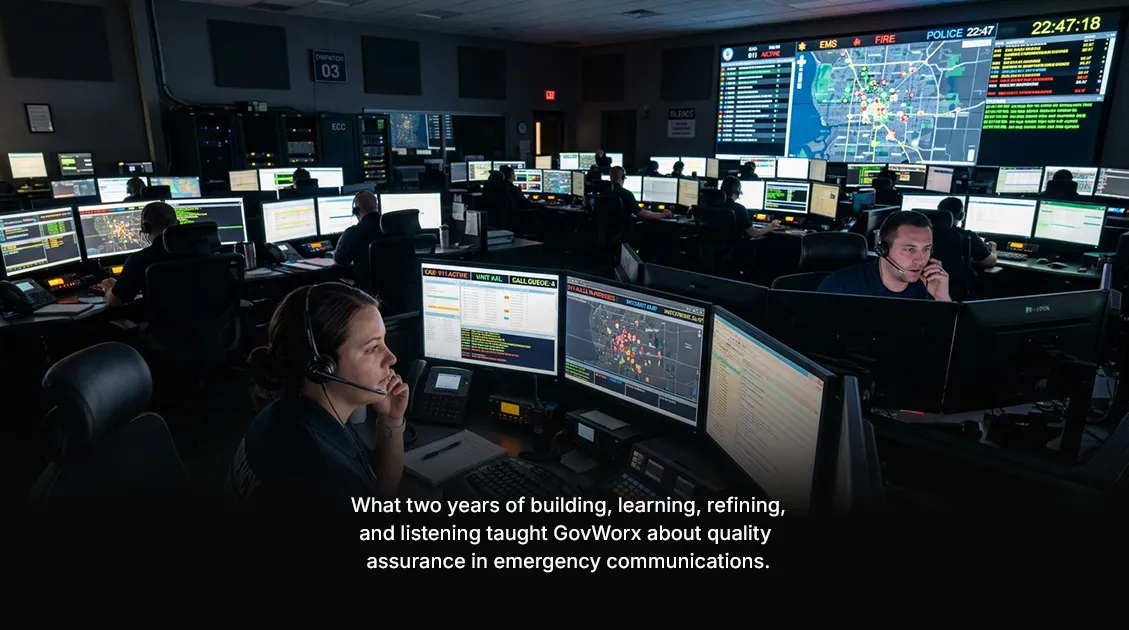
What two years of building, learning, refining, and listening taught GovWorx about quality assurance in emergency communications.
Take a 9-1-1 call. Transcribe it. Summarize it. Run it through a large language model. Call it AI-driven QA/QI.
That is not true quality assurance, and it is not quality improvement. At best, it is a starting point. At worst, it is a dangerous oversimplification of one of the most critical performance, training, risk, and recognition functions inside an Emergency Communications Center.
Real AI-driven QA/QI is something else entirely: the detailed, structured, policy-aligned, agency-specific analysis of what actually happened across the full incident lifecycle. That means the call and the radio. The CAD activity and the timing between actions. What was said and, just as importantly, what was not said. Whether local policy, protocol, and guidecard expectations were met. And whether the telecommunicator's work deserves coaching, correction, or recognition.
The distance between those two things is the entire point of this article.
A Transcript Is Not the Call
In 9-1-1, a call is not simply a conversation. It is an operational event. A transcript can reveal what was said, but it cannot tell the whole story.
A transcript will not tell you when the address was entered into CAD, how quickly the event was created, when the unit was assigned, or whether the data being entered actually matched the caller's evolving statements. Those are the details that determine whether a response was fast, accurate, and safe.
Radio reveals a different layer again. It is where dispatch decisions and prioritization happen, where responder safety communications live, where situational awareness and coordination play out, and where the critical timing of field updates becomes visible. Leave radio out, and you have evaluated only part of the job.
True QA, then, requires the call transcript and CAD together, radio traffic in full context, alignment to agency SOPs and guidecards, and timing analysis across the entire incident. It is not a language exercise. It is operational analysis.
The Work Is in the Criteria
QA/QI is only as strong as the criteria behind it. Generic prompts produce generic results, and emergency communications centers do not operate generically.
Some criteria are universal. Did the telecommunicator verify the location? Did they obtain a callback number? Did they identify the nature of the emergency, capture responder safety information, and maintain professionalism throughout? Those questions apply across every center.
But the most important questions are agency-specific, and that is where QA gets real. Did the telecommunicator follow this agency's abandoned-call policy? Did they apply this jurisdiction's domestic violence protocol? Did they use the correct guidecard for this call type, dispatch within the agency's expected timeframe, and document officer safety concerns according to local procedure?
That level of analysis does not happen by dropping a transcript into a model. It happens through detailed criteria development, policy ingestion, calibration, testing, and continuous agency-specific refinement.
Policy Ingestion Changes the Ceiling
When an ECC can ingest its own PDFs, SOPs, procedures, and guidecards, QA/QI becomes a living connection between what the agency says it expects and what actually happens on calls and radio traffic.
The contrast is stark. A transcript-only tool produces something like: "The call-taker gathered relevant information." A true AI-driven QA/QI system asks instead: "Did the call-taker gather the specific information required by this agency's policy for this incident type, at the appropriate point in the call, and document it correctly in CAD?"
Many centers have years of policy knowledge sitting in binders and shared drives. Those policies shape training, but they do not always shape daily QA at scale. AI changes that — but only when the system is built to understand, retrieve, apply, and evaluate against those policies in context.
Guidecard-Driven QA Is Different
Guidecards and structured call-handling models are not just training aids. They are operational expectations. A true QA system has to evaluate the full path a telecommunicator took against those expectations, and that involves several distinct steps.
First, the system has to identify the call type — it must understand and classify the incident correctly before evaluation can even begin. Then it has to recognize the path taken, tracing which decision steps the telecommunicator followed and in what order. From there, it compares that path against the agency's approved guidance, not a generic best-practice template. And finally, it has to distinguish deviation from error, separating a missed step from an irrelevant one, a justified deviation from a caller-driven adaptation.
That last point matters more than it might seem. Not every call is clean. The best telecommunicator work often happens when someone adapts, stabilizes chaos, and still keeps the incident moving. True QA/QI must be built for the real world, not for the ideal one.
Timing Matters, and Radio Has Been Overlooked
Quality is not only about what happened. It is about when it happened. Real QA/QI has to evaluate the sequence of actions across call audio, CAD activity, and radio communication. Was the right question asked soon enough? Was CAD updated in time for responders? Was critical safety information transmitted at the right moment? Was there a dispatch delay that affected the field response?
Radio, in particular, is long overdue for this kind of attention. It is where some of the most mission-critical work happens, yet for decades many centers have focused QA primarily on phone calls. Radio is fast, noisy, multi-speaker, and filled with local codes, unit identifiers, and context that is invisible to outsiders. That is exactly why AI-driven QA must include radio — not as an afterthought, not as a future feature, but as a core part of the quality picture.
QA/QI Should Find Excellence, Not Just Errors
If the only time a telecommunicator hears about QA is when something went wrong, the process becomes associated with discipline and fear. The best QA/QI programs also find and celebrate excellence.
Think of the call-taker who stayed composed with a terrified parent, the dispatcher who caught a subtle officer safety risk, or the telecommunicator who handled a chaotic multi-unit incident with precision. In a traditional program, those moments pass unnoticed. When a center can review far more calls and radio traffic at scale, it can surface far more moments worth recognizing — and that matters for morale, retention, and culture.
The Performance Loop: Workflow, Coaching, and Training
A technically impressive evaluation does not matter if the workflow is wrong. ECCs are busy. Supervisors are stretched. AI that creates more noise does not help; it overwhelms.
True QA/QI has to connect directly to action. The cycle is straightforward in principle — evaluate, route, coach, improve — but the routing is where it succeeds or fails. When a pattern is identified, the system should help answer the only question that matters next: now what? Exceptional performance should trigger automated recognition. Minor gaps should route to microlearning. Recurring patterns should reach a trainer. Safety concerns should escalate to a supervisor with full context — not just a score. The system must route findings intelligently rather than flooding the queue.
The Goal Is Not More AI. The Goal Is Better ECC Performance.
GovWorx did not spend two years learning QA/QI in order to say it uses AI. AI is not the mission. The mission is better emergency communications: helping telecommunicators grow, supervisors coach, trainers train, and centers recognize excellence.
The contrast is simple. On one side: a transcript in an LLM, a generic summary, a shallow score with no context. On the other: a connected, agency-specific performance improvement system built around the realities of 9-1-1, with policy ingestion, guidecard alignment, timing analysis, and human-centered coaching.
For a profession this important, the difference between a transcript review and true AI-driven QA/QI is not a feature gap. It is a mission gap.
The best AI is not the AI that tries to replace the judgment of 9-1-1 professionals. It is the AI that helps those professionals see more, coach better, recognize faster, train smarter, and improve continuously.


AI That Elevates the Impact of ALL Responders
and provide real-time support for first responders.
