

Which AI Tools Help Dispatch Centers Improve Employee Retention Through Better Training and Workflows?
 Link Copied!


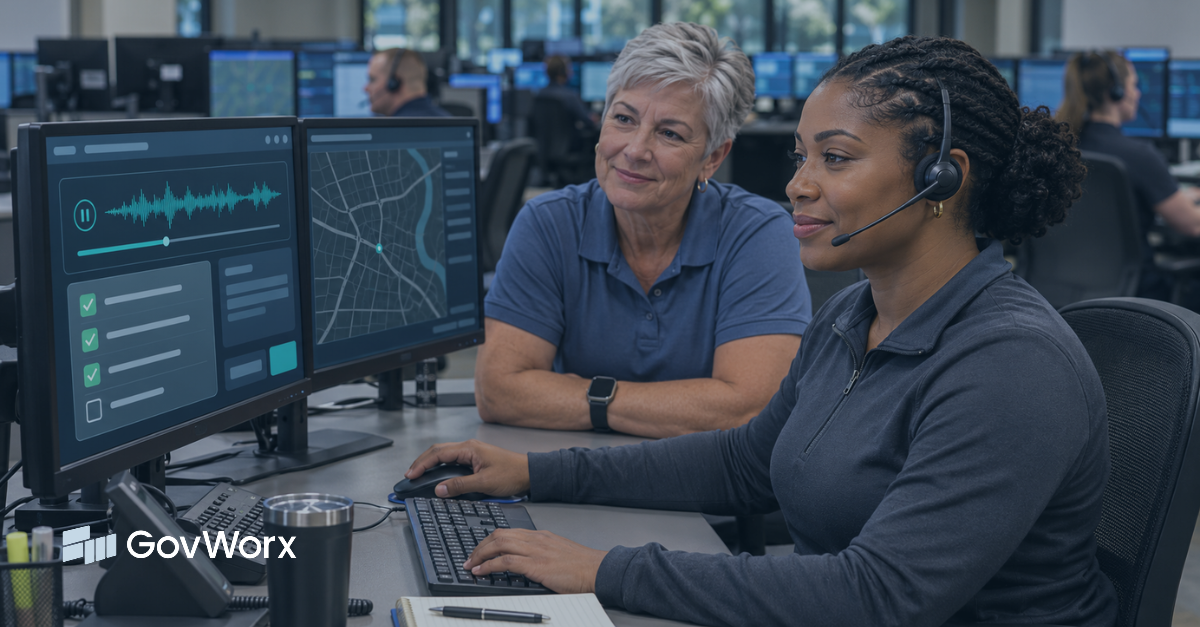
The AI tools that improve retention in 9-1-1 and dispatch centers are the ones that help telecommunicators throughout their career. That starts with aptitude-based hiring, realistic simulation training, real-time call guidance, and quality assurance that reviews every eligible call and recognizes good work. Tools that support a single stage don’t provide the continuity that helps develop, support and ultimately retain telecommunicators over time.
CommsCoach, the ECC Performance Platform from GovWorx, was built to connect all of those stages in one place. This post walks through what ECC leaders should look for when evaluating AI for retention, and how CommsCoach approaches each consideration.
Why Retention Is a Training and Workflow Problem
Telecommunicators rarely leave because of a single bad call. They leave when the weight of the job is not matched by the support around it. Tighter staffing, growing call complexity, constantly evolving SOPs, and increasing community scrutiny all land on the same people, shift after shift.
The pressure points show up early and compound over time:
- At hiring, traditional interviews cannot reveal whether a candidate has the composure and aptitude 9-1-1 work demands, so mismatched hires wash out during training.
- In training, months of unstructured role-play and subjective scoring leave trainees without realistic exposure to call speed and stress before they reach the floor.
- On the floor, veterans carry the burden of memorizing every policy, and newer call takers feel alone on unfamiliar call types.
- In QA, supervisors can manually review only a fraction of calls. Strong work goes unrecognized, feedback feels inconsistent, and telecommunicators hear mostly about what went wrong.
Each of these is a training or workflow gap. That is good news, because training and workflow are exactly where well-designed AI can help.
Top 6 Considerations When Choosing AI Tools to Improve Retention
Not every AI product marketed to ECCs will move the needle on retention. These are the questions that separate tools that add work from tools that give time and confidence back to your team.
- Does it cover the full career lifecycle? Retention starts before day one. Look for a solution that connects hiring, training, floor support, and QA so insights from one stage inform the next, rather than living in disconnected systems.
- Is training realistic and objectively scored? Trainees need repeated exposure to true-to-life calls and radio traffic, with consistent scoring that does not depend on which trainer is on shift.
- Does it support telecommunicators during live calls? Confidence on the floor matters most after training ends. Real-time, policy-driven guidance helps new call takers grow and lets veterans stop relying on memory for rare or updated call types.
- Does QA review every eligible call and recognize strengths? Full-coverage evaluation replaces sampling with a complete picture, and balanced feedback that highlights what went right is one of the most direct retention levers an ECC has.
- Does it reduce supervisor workload? If supervisors are still drowning in paperwork, they cannot coach. The right tool automates routine review and surfaces only the calls that need attention, including high-stress calls that may warrant a wellness check.
- Do you own and control your data? Your call data, evaluations, and training records belong to your agency. Look for open, documented, no-cost access to that data so you can use it with any system you choose, today and in the future.
How CommsCoach Supports Retention From Candidate Through Career
CommsCoach was designed around a simple idea: telecommunicators stay when they are well matched to the job, well prepared for it, supported while doing it, and recognized for doing it well. Each part of the platform addresses one of those needs, and together they form a continuous quality improvement system.
Hiring the right people with CommsCoach HIRE
Retention begins with fit. CommsCoach HIRE evaluates candidates across foundational, 9-1-1 specific, aptitude, and behavioral skills, including how composure holds up as scenarios escalate in difficulty. ECC leaders can set benchmarks across nine core competencies, often by testing their own current team, and compare candidates with consistent, AI-supported scoring. When paired with TRAIN, assessment results automatically shape each new hire's personalized learning path, so development starts on day one instead of week six.
Building real readiness with CommsCoach TRAIN
Many trainees leave because the floor feels nothing like the classroom. CommsCoach TRAIN closes that gap with AI-generated call and radio simulations, phased training paths, and an extensive microlearning library. Objective, automated scoring removes trainer-to-trainer variation, and a unified dashboard gives training coordinators a clear view of each trainee's progress. Trainees arrive on the floor having already practiced the pace and pressure of real 9-1-1 work.
Supporting every call with CommsCoach ASSIST
CommsCoach ASSIST brings agency policy into the live call. It identifies the nature of the call as it is transcribed, presents the policy-specific questions your agency requires, and autofills answers as the caller provides them, regardless of order. For the newest call takers, it works like a coach by their side long after training ends. For veterans, it stays in the background on routine calls and steps in on rare, complex, or recently updated call types. Built-in language detection and connection to translation services help bridge language gaps.
Turning QA into recognition with CommsCoach QA & Evals
CommsCoach QA automatically evaluates every eligible call and radio transmission, matches transcripts to CAD event data, and highlights both strengths and improvement opportunities. That full coverage matters for retention. When only a small sample of calls gets reviewed, the excellent work telecommunicators do every day goes unseen. With CommsCoach, supervisors can recognize strong performance consistently, deliver balanced and timely feedback, and focus coaching where it counts. Stress-related flags automatically identify difficult calls so supervisors can follow up with care.
Giving supervisors their time back
Across every module, the goal is the same: automate routine work so supervisors can lead. Pre-crafted reports, guided feedback, and focused views of the calls that matter reduce the back-and-forth between systems. Supervisors spend less time on paperwork and more time developing their people, which is one of the strongest predictors of whether those people stay.
Why a Unified Platform and Open Data Matter
Point solutions can each do one job well, but they leave ECC leaders stitching together the story of each telecommunicator by hand. When hiring, training, live call support, and QA share one platform, a growing dataset starts to reveal patterns no single tool could show: which competencies predict success, where training needs to evolve, and which shifts or call types are driving stress. As one ECC leader put it, the depth of unified data shows trends and insights that were not visible before.
That data is only valuable if your agency controls it. GovWorx believes ECCs should own their data outright and be able to access it freely. In practice, that means:
- Your agency owns its data. Call recordings, transcripts, evaluations, training records, and metadata belong to the customer, not the vendor that hosts them.
- Access is open and documented. A supported API gives your agency, and any third party you authorize, programmatic access to your data.
- No access fees. Retrieving or integrating your own data should never require an extra license, interface fee, or professional services engagement.
- No penalties for choice. Access should not be throttled or restricted because you also use another CAD, recorder, analytics platform, or AI system.
- Continuity is protected. API compatibility should hold through upgrades, with advance notice of changes and a full data export at contract end in a machine-readable format.
Open data supports retention indirectly but meaningfully. It lets ECC leaders bring performance, staffing, and wellness insights into the systems their organizations already use, without being locked into a single path.
Questions to Ask Any Vendor
Bring these questions into your next demo, RFI, or RFP. The answers will tell you quickly whether a tool is built to support your people or simply to sell another module.
- How does your solution connect hiring results to training plans, and training results to QA?
- Are simulations AI-generated with realistic call and radio traffic, and how is trainee performance scored?
- Does real-time guidance follow our agency's own policies, and can veterans keep it in the background?
- What percentage of eligible calls and radio transmissions does your QA evaluate automatically?
- How does your QA surface strengths and recognize good work, not just errors?
- How are high-stress calls identified, and how are supervisors alerted?
- Who owns our data, and can we and any third party we choose access it through a documented API at no additional cost?
- Will you restrict or degrade data access if we use a competing product alongside yours?
- How do you protect API compatibility through upgrades, and how do we retrieve our data at contract end?
-
Keeping Great Telecommunicators in the Chair
Retention is not solved by a single program or a single tool. It is built one hire, one training phase, one call, and one piece of recognition at a time. CommsCoach brings each of those moments into one ECC Performance Platform, so the people who answer 9-1-1 feel prepared, supported, and valued throughout their careers.
Support every telecommunicator from candidate through career. That is the goal.
Request a CommsCoach demo to see how HIRE, TRAIN, ASSIST, and QA work together for your ECC.


AI That Elevates the Impact of ALL Responders
and provide real-time support for first responders.
